APPLE'S iPhone has proved a sensation since it went on sale, rapidly becoming the most popular mobile phone in the US and selling almost 5 million handsets worldwide.
As the company prepares to sell the award-winning gadget in Egypt, users there will have to go without a popular feature: satellite navigation.
Egypt has banned the import of all global positioning system-enabled devices, claiming it is a military-grade technology that can be used to help pinpoint government buildings or be used by terrorists.
As a result, Egyptian buyers will not be able to use GPS. According to documents filed on Apple's website, "GPS is not available while in Egypt, or when using an Egyptian phone", which "is consistent with Egyptian law regarding GPS enabled devices". The company would not comment further.
Apple is not the first company to fall foul of the ban, which has been in place for five years.
The Finnish phone manufacturer Nokia has been in negotiations with the Egyptian Government to allow it to sell its GPS-enabled handsets but so far without success.
The ban has created a thriving blackmarket in GPS devices and high-end mobile phones.
Thousands of Egyptians sport handsets, such as the Nokia N95, while satnav gadgets are often used by groups trekking in the desert or off the beaten track.
"It's a direct link to the satellite, so there's no way they can stop you," said Stefan Geens, a Swedish blogger who lives in Cairo.
He said he regularly used GPS while travelling in remote parts of the country but had never seen anyone questioned about the technology.
Egyptian authorities have a notoriously testy relationship with new technology, having banned satellite dishes in the 1980s.
The Government has also struggled with the explosion of internet use, particularly blogging. In recent years a number of bloggers have been imprisoned because of what they have written, many of them charged with illegally criticising the president or inciting religious hatred.

The Port of Suez is located in Egypt along the northern coastline of the Gulf of Suez. The port and city mark the southern terminus of the Suez Canal, which runs north-south through Egypt from the Mediterranean Sea to the Gulf of Suez. The port serves vessels transporting general cargo, oil tankers, and both commercial and private passenger vessels. The port is also an important waypoint for Muslim pilgrims traveling to and from Mecca in Saudi Arabia. Several large vessels are visible in the Gulf of Suez and at various docks around the port.
An extensive petroleum refinery complex forms the southern coastal boundary of the Port of Suez. At the time this astronaut photograph was acquired, a smoke plume extended southwards into the Gulf of Suez—probably from a facility burning off gaseous byproducts of petroleum processing. Greenish blue regions offshore in the Gulf are most likely sediments stirred up by passage of ships. Similarly colored regions along the coastline are bottom sediments visible through the clear, shallow water.
Link Sexual harassment may no more go unpunished in Egypt. In a landmark verdict this week, a Cairo court sentenced a truck driver to three years in prison for groping a woman.
The crime happened last summer when Sherif Gomaa Gibrial slowed his truck and reached out and grabbed Noha Roushdy's breast while she was walking near her home. Roushdy wouldn't let it pass. She ran and and grabbed onto the truck, forcing Gibrial to stop.
By insisting on taking her harasser to court, Roushy broke the silence and shame many Egyptian women and tourists face when they confront profanities and assaults. In a patriarchal society, where the blame for sexual harassment is squarely put on the victim, harassed women prefer to remain discreet. However, Roushdy's insistence on justice and her cause celebre case may change such attitudes.
Sexual harassment is deemed one of Egypt's most insidious crimes.According to a report issued last summer by some local women's advocacy group, 83% of Egyptian women have been exposed to sexual harassment. Feminists have been complaining that there is no strict legal code to fight the phenomenon.
"This verdict will make young men think a thousand times before committing sexual harassment," said Roushdy.
The 27-year-old documentary director decided not to hide from society; on the contrary, she was brave enough to appear in court and have her photo taken by different news organizations.
— Noha El-Hennawy in Cairo
Photo: Roushdy in court (al-Masry al-Youm/ Mohamed Hossam Eddin)


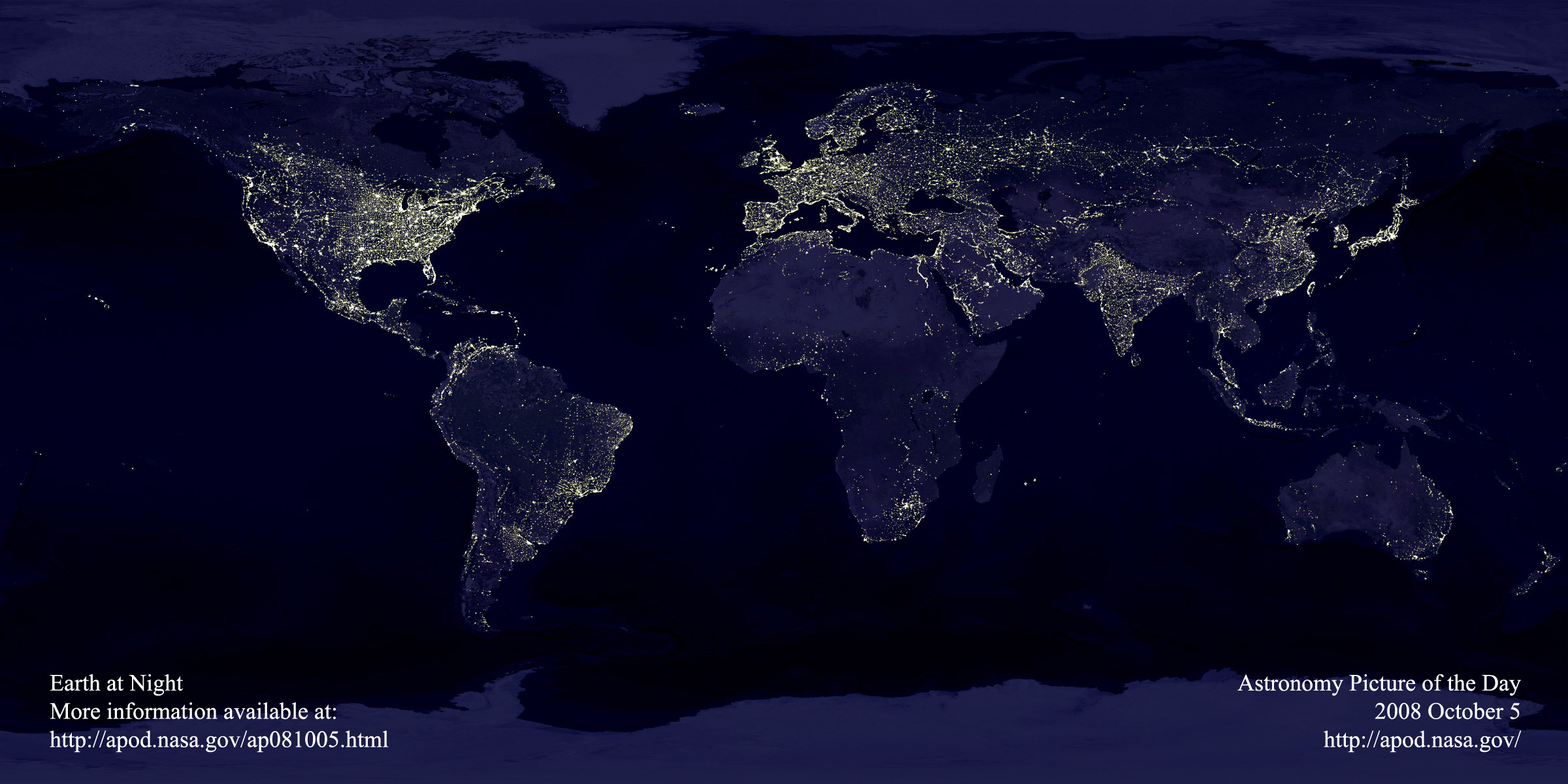
Explanation: This is what the Earth looks like at night. Can you find your favorite country or city? Surprisingly, city lights make this task quite possible. Human-made lights highlight particularly developed or populated areas of the Earth's surface, including the seaboards of Europe, the eastern United States, and Japan. Many large cities are located near rivers or oceans so that they can exchange goods cheaply by boat. Particularly dark areas include the central parts of South America, Africa, Asia, and Australia. Theabove image is actually a composite of hundreds of pictures made by the orbiting DMSP satellites.


PORT MORESBY, Papua New Guinea (Aug. 11, 2008) The Military Sealift Command hospital ship USNS Mercy (T-AH 19) anchored off the coast of Papua New Guinea in support of Pacific Partnership 2008. Pacific Partnership is a four-month humanitarian mission to Southeast Asia intended to build collaborative partnerships by providing engineering, civic, medical and dental assistance to the region.

The police caught the two people red-handed at a gas station in Dubai,Emirat.ru reports with reference to Gulf News.
In accordance with the Federal Penal Code of the United Arab Emirates, a public intake of food and beverages during daytime hours of the month of Ramadan is forbidden by Article 313. The article stipulates the punishment in the form of either a monetary penalty – up to 2,000 dirhems ($555) – or even a term of up to one month in prison.
The young people told the court that they were not Muslims and were thus unaware of the fact that their actions could be punishable.
The court took the mitigating circumstances into consideration, but found the defendants guilty, since ignorance did not exclude responsibility. The court ruled that the young people must pay the fine of 1,000 dirhems ($278) each.
The case became the first one in Dubai in violation of Article 313 since the beginning of the month of Ramadan on September 1.
Thousands of foreigners from Europe and Asia reside in the emirate of Dubai, the major tourist center of the Persian Gulf . Dubai is known as a relatively liberal region in comparison with other territories of the UAE. Tourists can be seen in the streets wearing shorts, whereas alcoholic beverages can often be available in bars and hotels.
This year, however, the authorities intend to remind all residents and guests of the emirate that they are staying on the territory of a Muslim country. There have been quite a number of incidents recently when the local police in plain clothes arrested women sunbathing topless, nudists and other violators of public order.
Many tourists acknowledge that that they do not always understand how they should behave in Dubai.
Guide-books advise tourists should always carry their IDs, or better their copies, with them for the majority of police officers wear plain clothes and can be rather meticulous in their inspections.

A thick plume of dust blew off the northern coast of Egypt, west of the Nile Delta, and over the Mediterranean Sea on September 25, 2008. The Moderate Resolution Imaging Spectroradiometer (MODIS) on NASA’s Aquasatellite captured this image the same day. In this image, the dust swirls in a counter-clockwise direction toward the northwest. A thinner plume in the east mimics the motion of the larger, thicker plume. Source points for this dust storm are not apparent in this image, but the dust likely arose from the sand seas farther inland in Egypt and/or Libya.
NASA image courtesy MODIS Rapid Response Team, Goddard Space Flight Center. Caption by Michon Scott.
Dust & Smoke: Topic Home | Archive | Related Links


CAIRO, Egypt (AP) — Twelve people have been killed in a collision between a delivery truck and a bus carrying European and Russian tourists in Egypt's Sinai peninsula. Another 37 are wounded.
The dead include seven tourists from the Netherlands, Russia and Ukraine, and five Egyptians. The head of emergency services for south Sinai says an exact breakdown of nationalities is not yet available.
Monday's crash occurred near the Red Sea resort town of Ras Sadr.
Egypt has a history of serious crashes because of speeding and poor road conditions. At least 8,000 people were killed in 2006 accidents.

 I went back to hospital today and the doctor had a look at the stitching on my ear and the bruising to my skull behind my ear and is pleased with the way both are coming along, and my stitches are already starting to fall out. While the ear was the biggest drama as it's such a delicate area and so was bleeding quite a lot they were more worried that I may have a hemorrhage as the ridge from just below my ear to half the way up my skull was rather large. But it appears that I'm healing ok and while I still can't swim I can take a shower and wash my hair which is something. And Doortje is bringing a helmet back from Holland for me as well. After looking me over the doctor asked me how the bike made out after my fall and he had a good laugh when I told him 'my wife took it away', no matter where we go in the world men always laugh about the same things.


This is not the conclusion of a scientific survey, but it is what routinely comes up in conversations around the region — in a shopping mall in Dubai, in a park in Algiers, in a cafe in Riyadh and all over Cairo.
“Look, I don’t believe what your governments and press say. It just can’t be true,” said Ahmed Issab, 26, a Syrian engineer who lives and works in the United Arab Emirates. “Why would they tell the truth? I think the U.S. organized this so that they had an excuse to invade Iraq for the oil.”
It is easy for Americans to dismiss such thinking as bizarre. But that would miss a point that people in this part of the world think Western leaders, especially in Washington, need to understand: That such ideas persist represents the first failure in the fight against terrorism — the inability to convince people here that the United States is, indeed, waging a campaign against terrorism, not a crusade against Muslims.
“The United States should be concerned because in order to tell people that there is a real evil, they too have to believe it in order to help you,” said Mushairy al-Thaidy, a columnist in the Saudi-owned regional newspaper Asharq al Awsat. “Otherwise, it will diminish your ability to fight terrorism. It is not the kind of battle you can fight on your own; it is a collective battle.”
There were many reasons people here said they believed that the attacks of 9/11 were part of a conspiracy against Muslims. Some had nothing to do with Western actions, and some had everything to do with Western policies.
Again and again, people said they simply did not believe that a group of Arabs — like themselves — could possibly have waged such a successful operation against a superpower like the United States. But they also said that Washington’s post-9/11 foreign policy proved that the United States and Israel were behind the attacks, especially with the invasion of Iraq.
“Maybe people who executed the operation were Arabs, but the brains? No way,” said Mohammed Ibrahim, 36, a clothing-store owner in the Bulaq neighborhood of Cairo. “It was organized by other people, the United States or the Israelis.”
The rumors that spread shortly after 9/11 have been passed on so often that people no longer know where or when they first heard them. At this point, they have heard them so often, even on television, that they think they must be true.
First among these is that Jews did not go to work at the World Trade Center on that day. Asked how Jews might have been notified to stay home, or how they kept it a secret from co-workers, people here wave off the questions because they clash with their bedrock conviction that Jews are behind many of their troubles and that Western Jews will go to any length to protect Israel.
“Why is it that on 9/11, the Jews didn’t go to work in the building,” said Ahmed Saied, 25, who works in Cairo as a driver for a lawyer. “Everybody knows this. I saw it on TV, and a lot of people talk about this.”
Zein al-Abdin, 42, an electrician, who was drinking tea and chain-smoking cheap Cleopatra cigarettes in Al Shahat, a cafe in Bulaq, grew more and more animated as he laid out his thinking about what happened on Sept. 11.
“What matters is we think it was an attack against Arabs,” he said of the passenger planes crashing into American targets. “Why is it that they never caught him, bin Laden? How can they not know where he is when they know everything? They don’t catch him because he hasn’t done it. What happened in Iraq confirms that it has nothing to do with bin Laden or Qaeda. They went against Arabs and against Islam to serve Israel, that’s why.”
There is a reason so many people here talk with casual certainty — and no embarrassment — about the United States attacking itself to have a reason to go after Arabs and help Israel. It is a reflection of how they view government leaders, not just in Washington, but here in Egypt and throughout the Middle East. They do not believe them. The state-owned media are also distrusted. Therefore, they think that if the government is insisting that bin Laden was behind it, he must not have been.
“Mubarak says whatever the Americans want him to say, and he’s lying for them, of course,” Mr. Ibrahim said of Hosni Mubarak, Egypt’s president.
Americans might better understand the region, experts here said, if they simply listen to what people are saying — and try to understand why — rather than taking offense. The broad view here is that even before Sept. 11, the United States was not a fair broker in the Arab-Israeli conflict, and that it then capitalized on the attacks to buttress Israel and undermine the Muslim Arab world.
The single greatest proof, in most people’s eyes, was the invasion of Iraq. Trying to convince people here that it was not a quest for oil or a war on Muslims is like convincing many Americans that it was, and that the 9/11 attacks were the first step.
“It is the result of widespread mistrust, and the belief among Arabs and Muslims that the United States has a prejudice against them,” said Wahid Abdel Meguid, deputy director of the government-financed Al Ahram Center for Political and Strategic Studies, the nation’s premier research center. “So they never think the United States is well intentioned, and they always feel that whatever it does has something behind it.”
Hisham Abbas, 22, studies tourism at Cairo University and hopes one day to work with foreigners for a living. But he does not give it a second thought when asked about Sept. 11. He said it made no sense at all that Mr. bin Laden could have carried out such an attack from Afghanistan. And like everyone else interviewed, he saw the events of the last seven years as proof positive that it was all a United States plan to go after Muslims.
“There are Arabs who hate America, a lot of them, but this is too much,” Mr. Abbas said as he fidgeted with his cellphone. “And look at what happened after this — the Americans invaded two Muslim countries. They used 9/11 as an excuse and went to Iraq. They killed Saddam, tortured people. How can you trust them?”
 I came off my bike again, this time it was a bit more serious. I cracked my head against the corner of a concrete wall and knocked off a small piece of my ear. As luck would have have it just as I got home, dripping blood all over myself, our friends and neighbours where just leaving for a check up at a private hospital as they are having a baby next week so they kindly dragged me along and they helped me get sorted out and sewn back up.