11 January 2009


09 January 2009
08 January 2009


07 January 2009


06 January 2009
05 January 2009


04 January 2009

02 January 2009


31 December 2008
Andy In Egypt


29 December 2008

25 December 2008
Happy Christmas

Cool tree! Kocht deze Kerstboom met ingebouwde lichtjes (kan het nog erger...) hier in Cairo. Dacht dat Brian het ongelooflijk kitsch zou vinden, maar tot mijn stomme verbazing vindt hij het prachtig...of toch niet?
11 December 2008
The Age: If GPS can't tell, you're in Egypt
APPLE'S iPhone has proved a sensation since it went on sale, rapidly becoming the most popular mobile phone in the US and selling almost 5 million handsets worldwide.
As the company prepares to sell the award-winning gadget in Egypt, users there will have to go without a popular feature: satellite navigation.
Egypt has banned the import of all global positioning system-enabled devices, claiming it is a military-grade technology that can be used to help pinpoint government buildings or be used by terrorists.
As a result, Egyptian buyers will not be able to use GPS. According to documents filed on Apple's website, "GPS is not available while in Egypt, or when using an Egyptian phone", which "is consistent with Egyptian law regarding GPS enabled devices". The company would not comment further.
Apple is not the first company to fall foul of the ban, which has been in place for five years.
The Finnish phone manufacturer Nokia has been in negotiations with the Egyptian Government to allow it to sell its GPS-enabled handsets but so far without success.
The ban has created a thriving blackmarket in GPS devices and high-end mobile phones.
Thousands of Egyptians sport handsets, such as the Nokia N95, while satnav gadgets are often used by groups trekking in the desert or off the beaten track.
"It's a direct link to the satellite, so there's no way they can stop you," said Stefan Geens, a Swedish blogger who lives in Cairo.
He said he regularly used GPS while travelling in remote parts of the country but had never seen anyone questioned about the technology.
Egyptian authorities have a notoriously testy relationship with new technology, having banned satellite dishes in the 1980s.
The Government has also struggled with the explosion of internet use, particularly blogging. In recent years a number of bloggers have been imprisoned because of what they have written, many of them charged with illegally criticising the president or inciting religious hatred.
30 November 2008
Earth Observatory: Port of Suez, Egypt

The Port of Suez is located in Egypt along the northern coastline of the Gulf of Suez. The port and city mark the southern terminus of the Suez Canal, which runs north-south through Egypt from the Mediterranean Sea to the Gulf of Suez. The port serves vessels transporting general cargo, oil tankers, and both commercial and private passenger vessels. The port is also an important waypoint for Muslim pilgrims traveling to and from Mecca in Saudi Arabia. Several large vessels are visible in the Gulf of Suez and at various docks around the port.
An extensive petroleum refinery complex forms the southern coastal boundary of the Port of Suez. At the time this astronaut photograph was acquired, a smoke plume extended southwards into the Gulf of Suez—probably from a facility burning off gaseous byproducts of petroleum processing. Greenish blue regions offshore in the Gulf are most likely sediments stirred up by passage of ships. Similarly colored regions along the coastline are bottom sediments visible through the clear, shallow water.
Link24 October 2008
Babylon & Beyond: Triumph over sexual harassment
 Sexual harassment may no more go unpunished in Egypt. In a landmark verdict this week, a Cairo court sentenced a truck driver to three years in prison for groping a woman.
The crime happened last summer when Sherif Gomaa Gibrial slowed his truck and reached out and grabbed Noha Roushdy's breast while she was walking near her home. Roushdy wouldn't let it pass. She ran and and grabbed onto the truck, forcing Gibrial to stop.
By insisting on taking her harasser to court, Roushy broke the silence and shame many Egyptian women and tourists face when they confront profanities and assaults. In a patriarchal society, where the blame for sexual harassment is squarely put on the victim, harassed women prefer to remain discreet. However, Roushdy's insistence on justice and her cause celebre case may change such attitudes.
Sexual harassment is deemed one of Egypt's most insidious crimes.According to a report issued last summer by some local women's advocacy group, 83% of Egyptian women have been exposed to sexual harassment. Feminists have been complaining that there is no strict legal code to fight the phenomenon.
"This verdict will make young men think a thousand times before committing sexual harassment," said Roushdy.
The 27-year-old documentary director decided not to hide from society; on the contrary, she was brave enough to appear in court and have her photo taken by different news organizations.
— Noha El-Hennawy in Cairo
Photo: Roushdy in court (al-Masry al-Youm/ Mohamed Hossam Eddin)
21 October 2008
Babylon & Beyond: Hey, you're not dying!

The man pictured on the cigarette pack appears to be dying.
He’s breathing through an oxygen mask, a wheezing testament to the ills of tobacco.
Only the man is not sick: He’s Hamdy Balala, an Egyptian driver for an ad company who finds himself the unwitting icon of a lawsuit.
Khaled Shaaban, a lawyer, says Balala’s posed picture, stamped on cigarette packs across the country, has duped and frightened the public.
Shaaban has sued Egyptian Health Minister Hatem El-Gabali for trickery. He wants the minister to resign. That’s not likely. Egypt has among the highest percentages of smokers in the world — 60% of adult males light up daily.
But Shaaban is passionate: “The simplest thing we want to see in an authority figure is credibility,” he told Egypt Today magazine. “If he deceived the public then he will never be credible, and he will never gain the public’s trust in any of his actions.”
The drama has become farce, especially for Balala, a heavy smoker with no health problems, who wanted to earn extra money posing for a public service advertisement. Now he’s teased by friends. Strangers accost him on the street.
He stopped talking to reporters after a picture surfaced on Facebook showing Balala smoking while holding up a cigarette pack with his hospitalized image.
Ah, the strange things that can happen when a noble idea gets marketed.
— Jeffrey Fleishman in Cairo
07 October 2008
Yann Arthus-Bertrand: Earth From Above

Road interrupted by a sand dune, Nile Valley, Egypt. Dunes cover nearly one-third of the Sahara, and the highest, in linear form, can attain a height of almost 1,000 feet (300 m). Barchans are mobile, crescent-shaped dunes that move in the direction of the prevailing wind at rates as high as 33 feet (10 m) per year, sometimes even covering infrastructures such as this road in the Nile Valley. [map] (© Yann Arthus-Bertrand)
06 October 2008
Astronomy Picture of the Day
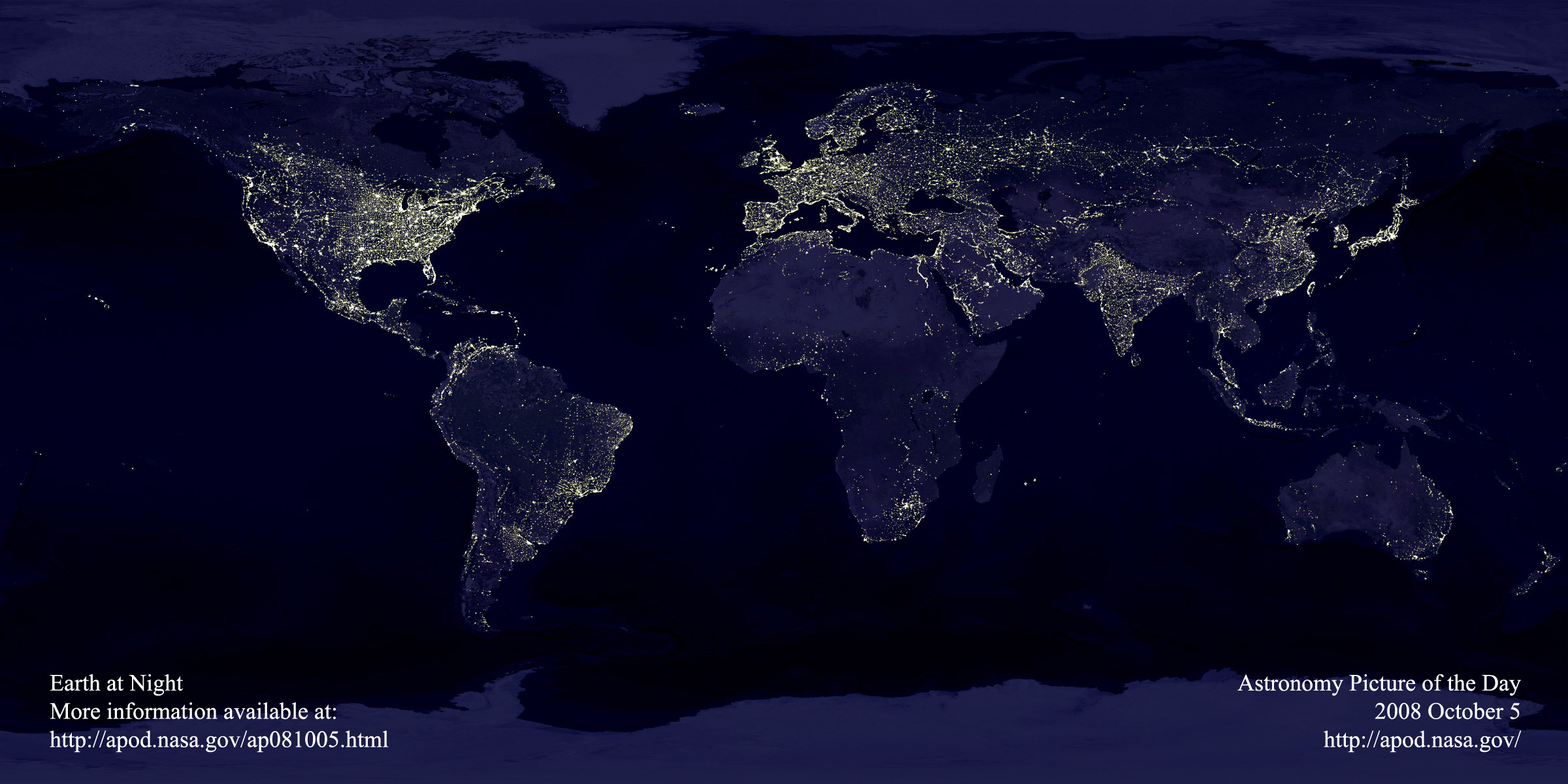
Credit: C. Mayhew & R. Simmon (NASA/GSFC), NOAA/NGDC, DMSP Digital Archive
Explanation: This is what the Earth looks like at night. Can you find your favorite country or city? Surprisingly, city lights make this task quite possible. Human-made lights highlight particularly developed or populated areas of the Earth's surface, including the seaboards of Europe, the eastern United States, and Japan. Many large cities are located near rivers or oceans so that they can exchange goods cheaply by boat. Particularly dark areas include the central parts of South America, Africa, Asia, and Australia. Theabove image is actually a composite of hundreds of pictures made by the orbiting DMSP satellites.
27 September 2008
My Brother

My brother Craig in Port Moresby, Papua New Guinea.

He has been serving aboard the Military Sealift Command hospital ship USNS Mercy. From Navy NewsStand:
PORT MORESBY, Papua New Guinea (Aug. 11, 2008) The Military Sealift Command hospital ship USNS Mercy (T-AH 19) anchored off the coast of Papua New Guinea in support of Pacific Partnership 2008. Pacific Partnership is a four-month humanitarian mission to Southeast Asia intended to build collaborative partnerships by providing engineering, civic, medical and dental assistance to the region.
26 September 2008
PRAVDA: Russian woman put on trial in Dubai for drinking juice in public

A 28-year-old Russian female, who visited Dubai on a tourist visa, and a 30-year-old male citizen of Lebanon, a salesman in a local store, were put on trial for drinking juice in a public place in the daytime during Muslim fasting.
The police caught the two people red-handed at a gas station in Dubai,Emirat.ru reports with reference to Gulf News.
In accordance with the Federal Penal Code of the United Arab Emirates, a public intake of food and beverages during daytime hours of the month of Ramadan is forbidden by Article 313. The article stipulates the punishment in the form of either a monetary penalty – up to 2,000 dirhems ($555) – or even a term of up to one month in prison.
The young people told the court that they were not Muslims and were thus unaware of the fact that their actions could be punishable.
The court took the mitigating circumstances into consideration, but found the defendants guilty, since ignorance did not exclude responsibility. The court ruled that the young people must pay the fine of 1,000 dirhems ($278) each.
The case became the first one in Dubai in violation of Article 313 since the beginning of the month of Ramadan on September 1.
Thousands of foreigners from Europe and Asia reside in the emirate of Dubai, the major tourist center of the Persian Gulf . Dubai is known as a relatively liberal region in comparison with other territories of the UAE. Tourists can be seen in the streets wearing shorts, whereas alcoholic beverages can often be available in bars and hotels.
This year, however, the authorities intend to remind all residents and guests of the emirate that they are staying on the territory of a Muslim country. There have been quite a number of incidents recently when the local police in plain clothes arrested women sunbathing topless, nudists and other violators of public order.
Many tourists acknowledge that that they do not always understand how they should behave in Dubai.
Guide-books advise tourists should always carry their IDs, or better their copies, with them for the majority of police officers wear plain clothes and can be rather meticulous in their inspections.
25 September 2008
EO Natural Hazards: Dust Storm off Egypt

A thick plume of dust blew off the northern coast of Egypt, west of the Nile Delta, and over the Mediterranean Sea on September 25, 2008. The Moderate Resolution Imaging Spectroradiometer (MODIS) on NASA’s Aquasatellite captured this image the same day. In this image, the dust swirls in a counter-clockwise direction toward the northwest. A thinner plume in the east mimics the motion of the larger, thicker plume. Source points for this dust storm are not apparent in this image, but the dust likely arose from the sand seas farther inland in Egypt and/or Libya.
NASA image courtesy MODIS Rapid Response Team, Goddard Space Flight Center. Caption by Michon Scott.
Dust & Smoke: Topic Home | Archive | Related LinksNatural Hazards Home
Dust Storm

We are having a bit of a dust storm today, it's not that bad but we're experiencing a very dry hot wind today and we can see a few clouds of dust blowing around.
24 September 2008

Subscribe to:
Posts (Atom)